
Hyperthyroidism, a condition marked by an overproduction of thyroid hormones, can have a real impact on quality of life. Extreme tiredness, nervousness, rapid weight loss and muscle wasting, heart palpitations and disturbed sleep often make daily life hard to manage. It can also be dangerous, for the heart in particular. It is absolutely essential to be followed by your doctor.
Alongside that, and in prevention too, naturopathy offers a range of natural tips for hyperthyroidism (the phrase “natural treatments” for hyperthyroidism is not the right one when we are talking about naturopathy, which does not “treat”). We will look at several of these tips in this article, as well as “the strategy” to take for acting on the root of the trouble in the case of Graves’ disease.
Briefly, what is hyperthyroidism?
The thyroid is a gland at the base of the neck whose function is absolutely vital (without a thyroid, people are on medication for life). We talk about hyperthyroidism when it produces an excessive amount of thyroid hormones, in particular thyroxine (T4) and triiodothyronine (T3).
There can be several forms, among them:
- Graves’ disease (an autoimmune condition, also called Basedow’s) is the most common type of hyperthyroidism, resulting from excessive stimulation of the thyroid by the immune system.
- Some people have hot thyroid nodules, which become autonomous and produce hormones in excess.
- Hashimoto’s, another autoimmune disease, often begins with a phase of hyperthyroidism, even though people then move into hypothyroidism.
- There is also De Quervain’s thyroiditis, which looks like a bad throat infection with many signs of hyperthyroidism (a medical emergency).
Some medicines can also bring on hyperthyroidism.
It is important to know that hyperthyroidism can have significant consequences for health if it is not dealt with properly. Common symptoms include unintentional weight loss, nervousness, irritability, disturbed sleep, heart palpitations / rapid heartbeat, tremor, muscle weakness, and irregular periods in women. So it is absolutely essential to see your doctor as soon as these signs of hyperthyroidism appear.
While waiting for medical treatment, at the start of a diagnosis, in prevention, or alongside it, several natural tips (“treatments”) can help ease the signs. Either way, it should not be left to drag on.
The first three natural tips (“treatments”) for hyperthyroidism
They are based on the first three naturopathic techniques.
Diet
Diet plays a part in managing hyperthyroidism.
- I talk about the foods to avoid with hyperthyroidism in the article The foods to avoid with thyroid problems, which I would encourage you to read. Stimulants like coffee, and too much red meat, are also best avoided.
- Among the foods to favour are raw vegetables, which are alkalising and antioxidant, meaning vitamins, minerals and remineralisation. Think too of raw goitrogenic foods (unless your iodine level is already too low), such as all the brassicas, turnips and radishes.
- Keep in mind too that it will be important to keep your blood sugar as steady as possible (and at a good level).
- Last but not least, favouring an anti-inflammatory diet is fundamental, as is bringing in nutrients that help look after the gut.

Physical activity
It helps you relax and hold on to muscle (and, as prevention, a good bone structure). That said, it can be hard to do when you are very tired, short of breath, and losing muscle. Either way, it is wise to talk it over with your doctor to be sure you can do the activity you have in mind.
Managing stress
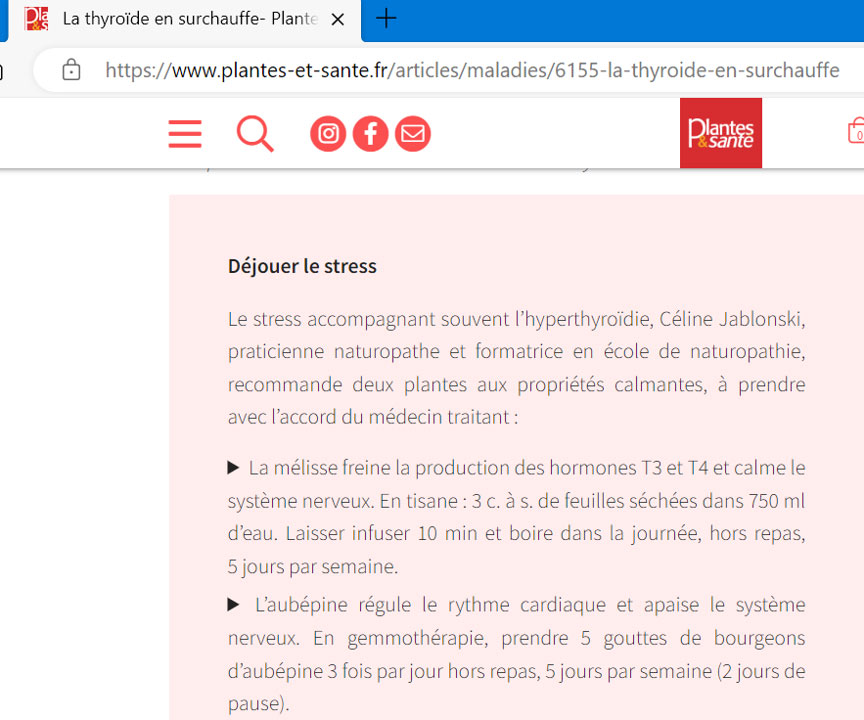
I would encourage you to read the article I wrote for the magazine Plantes et Santé, published in February 2024 (photo below). Stress makes the symptoms of hyperthyroidism worse. There are many stress-management techniques such as meditation, yoga, belly breathing and progressive muscle relaxation (the Jacobson method) to help you stay as calm as possible and reduce the harmful effects of stress on your thyroid.
Acting on the causes, with Graves’ disease in particular
With Graves’ disease, the trouble starts with the immune system. So that is the level we need to work on.
Intestinal permeability (leaky gut) lets foreign molecules (that the body does not recognise) pass into the blood, which encourages uncontrolled inflammatory and immune reactions. It is not the only factor (autoimmune diseases are usually multifactorial): there is a genetic factor, and triggers, among them a major emotional shock, certain viruses and bacteria, and so on. Smoking is a trigger and an aggravating factor, of the bulging eyes (exophthalmos) in particular.
Working to restore a good gut barrier, reduce inflammation and manage oxidative stress will be among the things put in place during naturopathic support. Of course there are likely other aspects to support as well, such as the adrenal glands (so, stress and tiredness), vitamin and mineral deficiencies, insulin resistance, and so on.
Plants and food supplements for hyperthyroidism

Certain vitamins, minerals and supplements can also help support thyroid function, in particular antioxidants such as coenzyme Q10, and vitamin D (which is immunomodulating). Anything that helps restore the gut barrier will be needed too. For that, it is best to get support, because this really has to be tailored to the individual. It is not possible to advise the same things for everyone.
As for plants, the ones used are those with a calming action.
- Lemon balm: this plant is known for its calming properties. It can help reduce the anxiety and over-excitability that go with hyperthyroidism. It is contraindicated in pregnant and breastfeeding women.
- Bugleweed (European or Virginia): this plant is traditionally used to reduce the production of thyroid hormones. It is contraindicated in pregnant and breastfeeding women.
- Hawthorn (as bud extract) helps regulate the heart rhythm and soothe.
- Myrrh essential oil (not to be confused with green myrtle, which has the opposite effect): dilute it to 10% in a vegetable oil and apply it twice a day to the neck for three weeks. It is contraindicated in pregnant and breastfeeding women, and this use is for adults only.
Some medicinal mushrooms, such as reishi, are indicated in Graves’ disease. Reishi has a cortisol-regulating action, helps calm anxiety, is immunomodulating thanks to its beta-glucans, and is antioxidant.

If you take supplements and/or plants as natural support for hyperthyroidism, whether you are on medication or not, I strongly recommend talking it over with your doctor (the aim is not to flip into hypothyroidism), and getting naturopathic support.
FAQ
Can naturopathy treat hyperthyroidism?
What is Graves disease?
Which foods are worth looking at with hyperthyroidism?
Are plants and supplements safe for hyperthyroidism?

I am Céline Jablonski, a certified naturopath based in Paris and working by video call. I am a member of the Syndicat des Professionnels de la Naturopathie and I teach at a school of naturopathy. I help people find their physical and emotional balance again through naturopathic techniques (diet, physical activity, stress management, the use of plants and so on).
Through this blog I share, in a down-to-earth way, the knowledge and experience I find useful, to help you feel better.
This advice is not a substitute for seeing your own healthcare professional, and should never keep you from doing so.