
The holidays already feel a long way off (are you one of those already dreaming of the October half-term?), and quite a few people find themselves, by late September or early October, well and truly tired. September is often a particularly demanding time, whether at work, or personally with the back-to-school season for example, the return to the daily grind, and the dip in energy at the end of September.
So here are 6 naturo tips for autumn tiredness, or at least for heading it off.
In a naturopathy consultation, the first thing we look for is the reason, or reasons, for the tiredness, so we can act on it. As the possibilities are vast, I am going to assume here that there is no underlying problem, just tiredness after September, a tiring and/or stressful back-to-school, a draining environment. But if this tiredness (physical and/or mental) persists, I would encourage you to see your doctor, and to see a naturopath alongside too. There are several things naturopathy can offer that are not covered below, but it will depend on the cause of the tiredness, and so it needs to be tailored to you.
I have tried to put them in an order, but really it depends on each person, where you are starting from, and what you need most.
1. First naturo tip against autumn tiredness: pamper your sleep

Yes indeed, because we are gradually going into “hibernation” mode.
The rhythm is already not the same as in summer, the alarms going off much earlier while the sun rises later and later. As I write this article we are not feeling it too much yet, but the shortening days bring a drop in daylight.
So the point is to avoid building up tiredness, and with it, through the day, irritability, less concentration, more cravings, poorer immunity. The list is long.
If you want to fall asleep earlier but cannot manage it, I suggest reading the advice in the article on sleep apnoea (the practical tips and the plants there will apply). I recommend getting ahead a week before going back, going to bed a little earlier each day, and getting up a little earlier each day too, even if you are tired. Keeping the same wake and sleep rhythm is important.
Melatonin (1 mg) 30 minutes before bed helps too. It is, however, not advised, except on medical advice, for pregnant and breastfeeding women, for children and adolescents, in autoimmune disease, in depression, high blood pressure, epilepsy, and behavioural and personality disorders (source: Vidal). It is of course also not advised if you need to do anything that requires your alertness.
And the other way round, get yourself out into daylight, and if you cannot, or if waking up is really too hard, there is always the option of investing in a light-therapy lamp, if you can afford it.
2. Take time for yourself, and relax
Easier said than done, but essential. You surely already give a lot of your time to others, so this time for yourself is a must. You can only give when you are recharged yourself. It will also give you the feeling of taking back the reins, of not being quite so overwhelmed.
I suggest putting in place:
- each day, a moment to relax; for example:
- a breathing session for some (a longer out-breath than in-breath, which I talk about in many other articles),
- meditation for others,
- or yoga,
- or singing, or listening to a piece you love, or playing your musical instrument,
- or laughter yoga,
- or knitting, or embroidery,
- or drawing (a mandala or whatever), or writing.
There are plenty of possibilities, and everyone has their own method. But I really do encourage you to put this in place, even just 5 minutes a day.
- Before coming home in the evening in particular (or, if you work from home, before logging off): give yourself a little decompression airlock (see the examples above). It helps you throw yourself less at the packet of biscuits, communicate better with your children (who may not have done their homework yet, or left their room in an impossible state, you know what I mean, I think) and so on.
- At least once (?) a week: another moment for yourself: an outing with friends, a massage (at a salon or from your partner), and so on.
- Taking part in a talking circle (women’s circles, mixed ones, or men’s), such as the Red Tents of Paris, or the Nouveaux Guerriers.

3. Do some sport, and get outside for fresh air
Starting to look like a list of New Year’s resolutions? 😊
Movement boosts the mitochondria (the little energy factories in your cells). Physical activity also lets you let off steam and clear out stress, among other things. I will not go into all the benefits of regular exercise here, they are many and you probably know them already. So I will stress getting outside, ideally in nature: a park, a wood, a forest, the sea, a good walk at least once a week, and otherwise several times in a park near home. It helps you reconnect with nature and get some oxygen.
So even if you do enough sport but indoors (gym, badminton, pool and so on), getting outside is recommended, somewhere green if you can.
4. Get organised… and delegate too 😊
This is a slightly generic tip, which does not quite belong to naturopathy, you might say, but it fits into a wellbeing goal. So let’s talk briefly about the famous to-do list, and putting everything that is in your head onto it to offload, while being aware you will only get through half of it.
Once the to-do list is done, you can block out slots in your diary for all of it. That goes for your own moments too (see above).
Sharing out the family chores is a subject too, which can be the focus of a weekly family meeting (every Saturday at the end of the day, for example), around a healthy apéro. It is then up to you, according to how you parent, how things go if a child “deliberately” does not stick to the agreed plan.
Perhaps you can also ask your family for help if they live nearby, have the time and are willing, of course? Whether it is your in-laws cooking a few meals, your mother baking cakes, or minding the children while you go out. I am not telling you anything new, but I just want to stress that people are generally delighted to help and lend a hand, when they can of course.
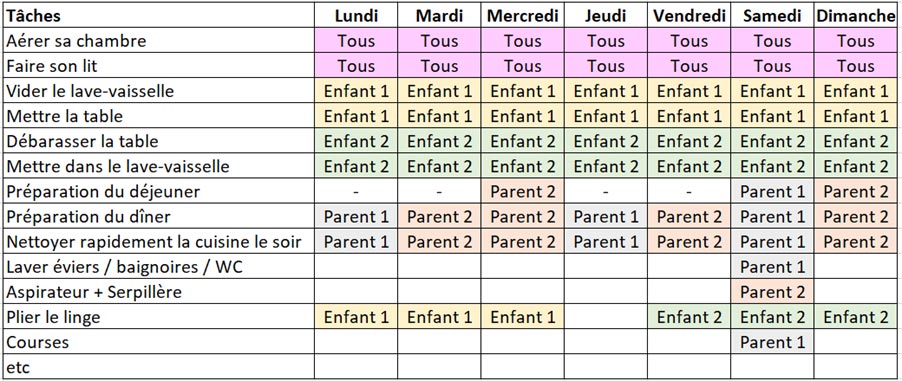
Speaking of organisation, do you know about batch cooking?
The idea is to write down all the meals for the coming days (at least the next 3), make your shopping list, and take 2 hours at the weekend, for example, to cook it all and keep it chilled. So it takes a bit of organising and setting aside time, but after that your mind is at ease.
5. Diet, to help prevent autumn tiredness
Go for a diet rich in vegetables and colour, with 1 or 2 pieces of fruit a day if you like. Try to work in raw vegetables for their vitamins and minerals, or lightly steamed ones. Here are the options in early autumn in mainland France:
Squash, carrots, lettuces, celeriac and celery, parsnip, beetroot, spinach, mushrooms, and the brassicas (cauliflower, red and white cabbage, broccoli, and even Brussels sprouts, which can be eaten raw when cut very finely) (be careful not to eat too much raw brassica if you have hypothyroidism with low iodine).
Do not forget to eat enough protein, in the morning and at midday in particular, to allow (among other things) a good synthesis of neurotransmitters like dopamine (the morning starter), serotonin (for good mood) and acetylcholine (for memory and concentration).
The good fats should not be forgotten either:
- those from nuts, without overdoing it: almonds, walnuts, Brazil nuts, hazelnuts and so on,
- those from oily fish,
- those from vegetable oils rich in omega-3: rapeseed oil and above all walnut, flaxseed and camelina oils.
6. Last naturo tip against autumn tiredness: if needed, get help from plants and supplements
I have already mentioned that some plants can help with sleep.
The champions for supporting vitality are the adaptogenic plants, which will support your stress management too. I am not talking about endless coffee, which rosemary can usefully replace.
There are many, and they all have their specifics. For example, if you are anticipating stress and tiredness with a sleep problem this autumn, ashwagandha will be your ally. For tiredness with a weakened immune system, eleuthero (Siberian ginseng) will be worth considering. Be careful: just because these are natural products does not mean you can use them with your eyes closed. I would encourage you to pay attention to their contraindications, and do ask your health professional, your pharmacist, or during your naturopathy consultation.
Vitamin D3, for its part, is essential, because many people are deficient, and because vitamin D affects mood, vitality and immunity. From late September at our latitudes, we no longer make vitamin D from sun exposure (not until April). Diet often does not meet the need, and a supplement is often necessary.
A magnesium supplement is probably needed by most of us too (80% of people are deficient). A magnesium in the bisglycinate or gluconate form will be well absorbed, and most of the time you can take 300mg a day without a problem (of elemental magnesium), split into 2 doses a day.

Among these 6 naturo tips for autumn tiredness, which seem the easiest to you to put in place (or which do you already do)?
Which seem harder?
If you need support to put these lifestyle tips in place, do feel free to get in touch for a discovery call or a consultation.
FAQ
Why am I so tired in autumn?
What helps most with autumn tiredness?
Which supplements are worth considering in autumn?
Is melatonin a good idea for sleep?

I am Céline Jablonski, a certified naturopath based in Paris and working by video call. I am a member of the Syndicat des Professionnels de la Naturopathie and I teach at a school of naturopathy. I help people find their physical and emotional balance again through naturopathic techniques (diet, physical activity, stress management, the use of plants and so on).
Through this blog I share, in a down-to-earth way, the knowledge and experience I find useful, to help you feel better.
This advice is not a substitute for seeing your own healthcare professional, and should never keep you from doing so.